Our Remote Therapy for Autism Spectrum Disorder (ASD) and Aphasia project leverages Virtual Reality (VR) to create an immersive platform that replicates everyday life activities (ELA) for patients diagnosed with ASD and Aphasia. The goal is to provide interactive, cost-effective speech and cognitive therapy solutions, enabling patients to receive treatment remotely, especially during the pandemic, in a way that enhances both learning and interaction.
Approach
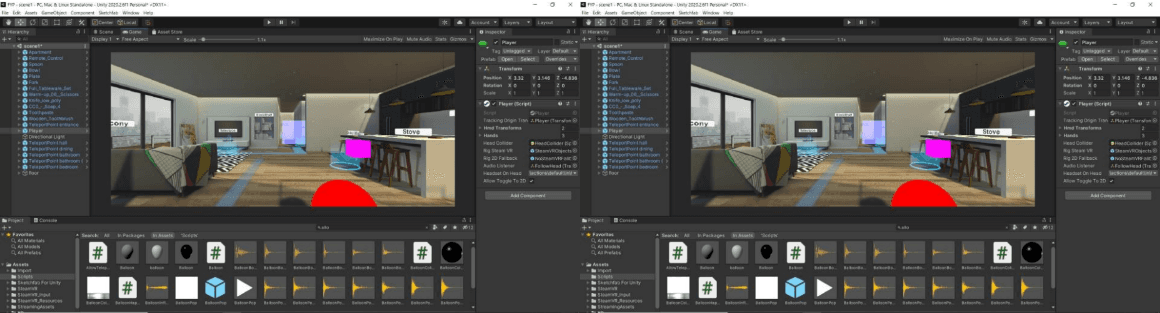
We designed an immersive environment where patients could navigate a virtual house and perform language, memory, and cognitive tasks. By integrating visual and auditory cues, patients interact with avatars to learn through exploration, practice vocabulary, and complete everyday life activities. Our team used VR to offer a rich, hands-on experience for the patients.
Identifying Unique Challenges
One of the key challenges was ensuring that the virtual environment was immersive enough to replicate everyday life activities while keeping it user-friendly for patients with ASD and Aphasia. We also had to ensure that the therapy tasks, such as vocabulary practice and cognitive exercises, were both intuitive and effective within a VR setting.
Resolving Complex Problems
We used Marching Parabola Signed Distance Fields to map textures and objects accurately in the virtual space, allowing patients to interact with items in the house environment. Additionally, we combined haptics, audio, and proprioception to make the VR experience as realistic and immersive as possible, ensuring patients could perform tasks in a meaningful way.
User-Centric Design
Our design prioritized the user experience, ensuring that patients could practice at their own pace. We incorporated place, plausibility, and embodiment illusions to make the environment feel as close to real life as possible. The platform allows users to navigate, interact with objects, and receive feedback in ways that mimic real-world interactions, making the therapy process more engaging and personalized.
Meeting User Needs
The therapy platform was built to be accessible remotely, allowing patients to practice speech and cognitive therapy without needing a therapist physically present. This made the solution especially beneficial during the pandemic, where in-person therapy was limited. The platform’s flexibility allowed patients to improve communication, daily living, and social skills through self-paced, immersive tasks.
Conclusion
Our AR/VR-based therapy platform successfully provided an immersive, remote therapy solution for patients with ASD and Aphasia. By replicating everyday activities in a virtual environment, we helped improve speech and cognitive skills, making therapy more engaging, affordable, and accessible from home. This solution not only provided therapy during the pandemic but also showed great potential for long-term use in remote treatment settings.
Tools
Unity 3D
Oculus (Meta Quest 2)
Visual Studio
Our Remote Therapy for Autism Spectrum Disorder (ASD) and Aphasia project leverages Virtual Reality (VR) to create an immersive platform that replicates everyday life activities (ELA) for patients diagnosed with ASD and Aphasia. The goal is to provide interactive, cost-effective speech and cognitive therapy solutions, enabling patients to receive treatment remotely, especially during the pandemic, in a way that enhances both learning and interaction.
Approach
We designed an immersive environment where patients could navigate a virtual house and perform language, memory, and cognitive tasks. By integrating visual and auditory cues, patients interact with avatars to learn through exploration, practice vocabulary, and complete everyday life activities. Our team used VR to offer a rich, hands-on experience for the patients.
Identifying Unique Challenges
One of the key challenges was ensuring that the virtual environment was immersive enough to replicate everyday life activities while keeping it user-friendly for patients with ASD and Aphasia. We also had to ensure that the therapy tasks, such as vocabulary practice and cognitive exercises, were both intuitive and effective within a VR setting.
Resolving Complex Problems
We used Marching Parabola Signed Distance Fields to map textures and objects accurately in the virtual space, allowing patients to interact with items in the house environment. Additionally, we combined haptics, audio, and proprioception to make the VR experience as realistic and immersive as possible, ensuring patients could perform tasks in a meaningful way.
User-Centric Design
Our design prioritized the user experience, ensuring that patients could practice at their own pace. We incorporated place, plausibility, and embodiment illusions to make the environment feel as close to real life as possible. The platform allows users to navigate, interact with objects, and receive feedback in ways that mimic real-world interactions, making the therapy process more engaging and personalized.
Meeting User Needs
The therapy platform was built to be accessible remotely, allowing patients to practice speech and cognitive therapy without needing a therapist physically present. This made the solution especially beneficial during the pandemic, where in-person therapy was limited. The platform’s flexibility allowed patients to improve communication, daily living, and social skills through self-paced, immersive tasks.
Conclusion
Our AR/VR-based therapy platform successfully provided an immersive, remote therapy solution for patients with ASD and Aphasia. By replicating everyday activities in a virtual environment, we helped improve speech and cognitive skills, making therapy more engaging, affordable, and accessible from home. This solution not only provided therapy during the pandemic but also showed great potential for long-term use in remote treatment settings.
Tools
Unity 3D
Oculus (Meta Quest 2)
Visual Studio