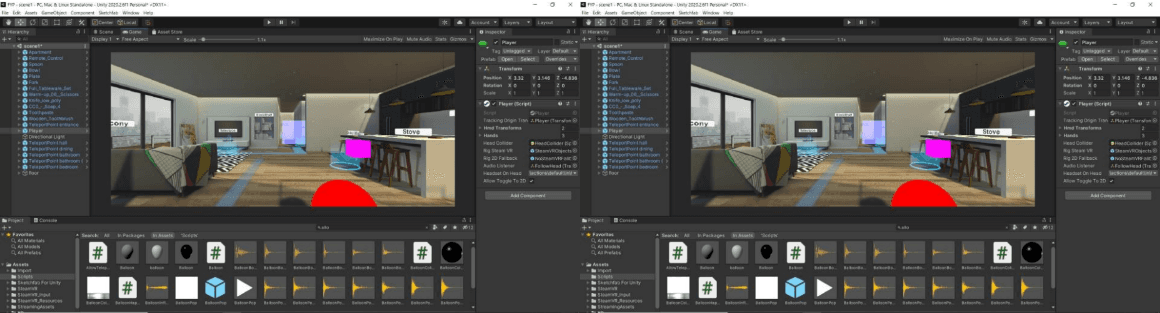
SaberSense is an innovative virtual reality experience designed to immerse users in a 3D world where they can sort objects by size while navigating through spatial audio and haptic feedback. This project aims to explore how integrating haptic feedback—both with and without sound—affects user immersion in virtual environments. By creating an engaging interactive experience, we sought to understand the dynamics of haptic perception and its impact on the overall user experience in VR.
Approach
Our team utilized the Double Diamond Methodology, which includes the phases of Discover, Define, Develop, and Deliver. This approach allowed us to thoroughly research and refine our ideas about how sound and haptics could work together to enhance the immersive quality of the VR environment.
Challenges
One of the unique challenges was understanding how to effectively integrate haptic feedback and spatial audio within the VR framework. We needed to determine how different feedback types could influence user immersion and whether combining sound with haptic sensations would yield a more realistic experience than haptics alone.
Resolving Complex Problems
To resolve these challenges, we formulated a research question: How does the integration of haptic feedback, both with and without sound, impact user immersion in VR environments? We conducted experiments to evaluate the impact of various feedback types, focusing on user interactions within the VR space while accounting for hardware limitations inherent to the Oculus Meta Quest 2.
User-Centric Design
The primary goal was to enhance the sense of presence and realism in the VR experience. By understanding how users interact with sound and haptics, we aimed to create a more natural and immersive environment that catered to the needs of users seeking interactive experiences. The primary goal was to enhance the sense of presence and realism in the VR experience. By understanding how users interact with sound and haptics, we aimed to create a more natural and immersive environment that catered to the needs of users seeking interactive experiences.
Our Solution :
The integration of sound and haptic feedback significantly improved perceived immersion, resulting in a more realistic experience for users. Participants completed tasks 15 seconds faster on average, highlighting the effectiveness of combining these sensory elements. Individual responses indicated variability in how users perceived sound and haptics, suggesting the need for larger and more diverse study groups for conclusive results. Overall, participants reported a more natural environment when both sound and haptics were integrated compared to haptic feedback alone.
Tools
Unity 3D
Oculus (Meta Quest 2)
SaberSense is an innovative virtual reality experience designed to immerse users in a 3D world where they can sort objects by size while navigating through spatial audio and haptic feedback. This project aims to explore how integrating haptic feedback—both with and without sound—affects user immersion in virtual environments. By creating an engaging interactive experience, we sought to understand the dynamics of haptic perception and its impact on the overall user experience in VR.
Approach
Our team utilized the Double Diamond Methodology, which includes the phases of Discover, Define, Develop, and Deliver. This approach allowed us to thoroughly research and refine our ideas about how sound and haptics could work together to enhance the immersive quality of the VR environment.
Challenges
One of the unique challenges was understanding how to effectively integrate haptic feedback and spatial audio within the VR framework. We needed to determine how different feedback types could influence user immersion and whether combining sound with haptic sensations would yield a more realistic experience than haptics alone.
Resolving Complex Problems
To resolve these challenges, we formulated a research question: How does the integration of haptic feedback, both with and without sound, impact user immersion in VR environments? We conducted experiments to evaluate the impact of various feedback types, focusing on user interactions within the VR space while accounting for hardware limitations inherent to the Oculus Meta Quest 2.
User-Centric Design
The primary goal was to enhance the sense of presence and realism in the VR experience. By understanding how users interact with sound and haptics, we aimed to create a more natural and immersive environment that catered to the needs of users seeking interactive experiences. The primary goal was to enhance the sense of presence and realism in the VR experience. By understanding how users interact with sound and haptics, we aimed to create a more natural and immersive environment that catered to the needs of users seeking interactive experiences.
Our Solution :
The integration of sound and haptic feedback significantly improved perceived immersion, resulting in a more realistic experience for users. Participants completed tasks 15 seconds faster on average, highlighting the effectiveness of combining these sensory elements. Individual responses indicated variability in how users perceived sound and haptics, suggesting the need for larger and more diverse study groups for conclusive results. Overall, participants reported a more natural environment when both sound and haptics were integrated compared to haptic feedback alone.
Tools
Unity 3D
Oculus (Meta Quest 2)